When it arrived a couple of years ago, the Hyundai Santa Fe was offered with two power sources. Back in 2024, we tried out the turbocharged internal combustion engine version. It certainly added a lot of performance for this in-between-size, three-row SUV.
In-between size? Lately, a lot of SUVs are equipping them with a third row, even though they are essentially smaller than their true third row counterparts. One outlet called these SUVs “2.5 rows.” We’re scratching our heads like you are, but we will explain later.
Back to what’s underneath the hood. Hyundai does a great job with hybrid drivelines of late. They’re offering them in almost every model. We were curious about the one equipped in the Hyundai Santa Fe. That is why we happy to get in one to review for you.
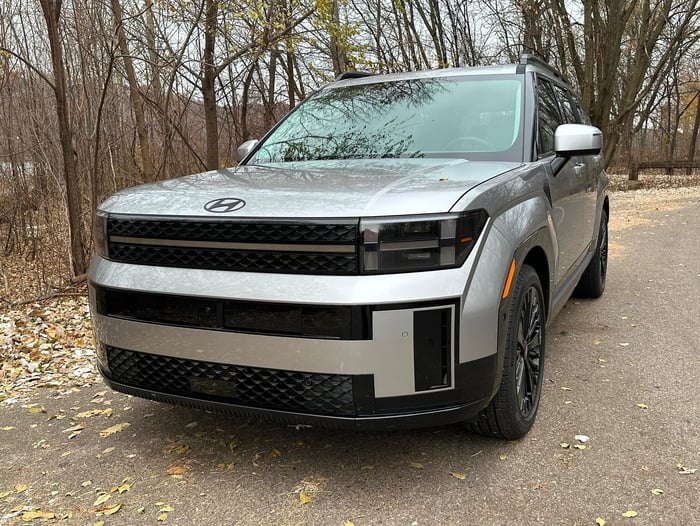
The one things that has not changed is its boxy exterior design. With the bumper and lower grille jutting out, it is framed by an LED lightning cluster which the driving lamps and turn signals form an H when illuminated. An upper grille frames the two lightning units. 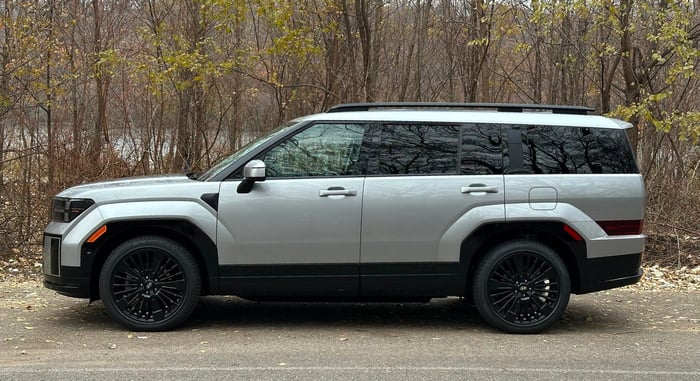
The profile is upright. All four doors open wide, as part of a large glass profile. The C-pillar breaks up the glasshouse with a flap for a grab handle. The wheel arches themselves are shaped using angles. The rear end is slightly angled slightly down with the taillight units placed across the lower part of the liftgate area and extended back towards the rear wheel arches. The signature H lighting shows up at the rear LED lighting units.
Our Calligraphy Hybrid tester adds a distinctive mesh grille texture, black arches and black badging. It also wears a set of black-finished 20-inch wheels on low-profile tires.
We like the current-generation model’s minimalistic interior design. A curved flat panel integrates the digital instrument cluster and infotainment touchscreen – both screens are 12.3-inches. This is augmented by a 10-inch head-up display. The transmission is actuated by a twist control at the end of a rigid stalk from the steering column. Climate controls are now accessed by another touchscreen at the base of the center console. Every switch and control are excellent to the touch and logical.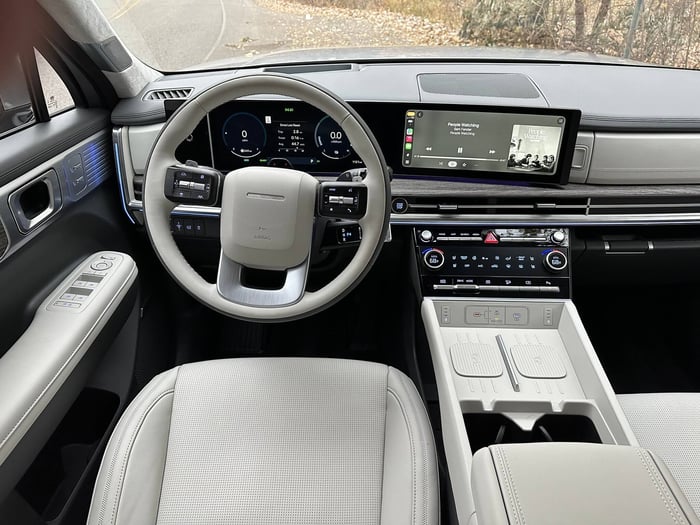
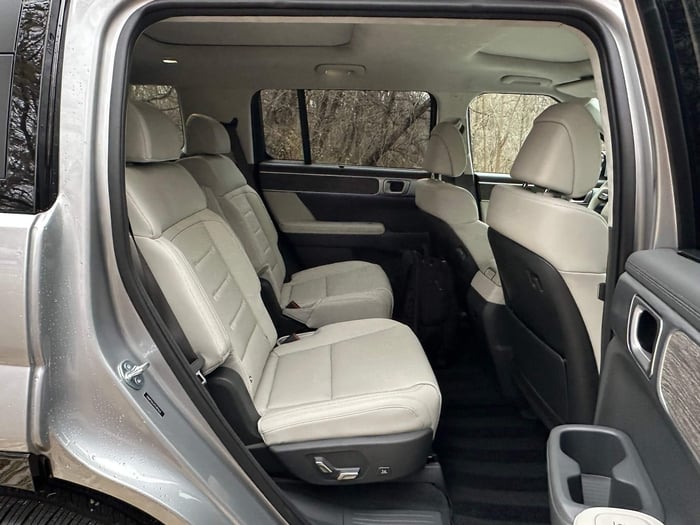
The seats on this Calligraphy Hybrid model are upholstered in a light-colored Nappa leather. There are three rows of seats, including the second-row captain’s chairs. The front seats are supportive and comfortable, as are the second row-seats. Access to the third row is done with a button on top of the second-row seatbacks. 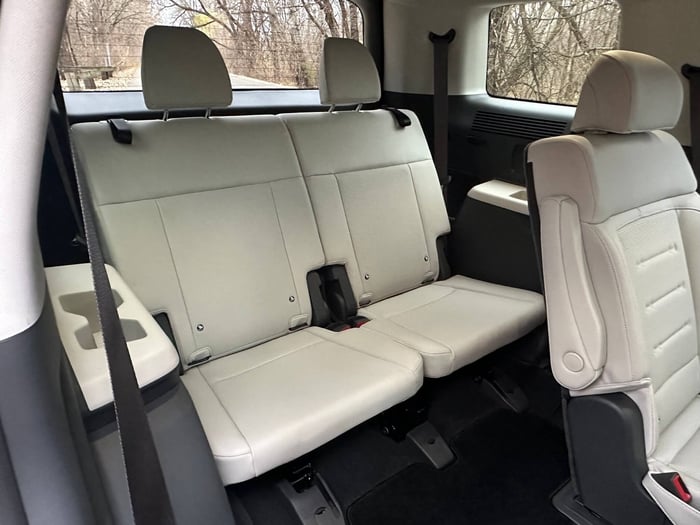
The cargo space starts with 14.6 cubic feet with the third-frow seats up. Folding the third-row seats will expand the cargo hold to 40.5 cubic feet. Ultimately, cargo space will expand to 79.6 cubic feet with both the second- and third-row seats folded down. 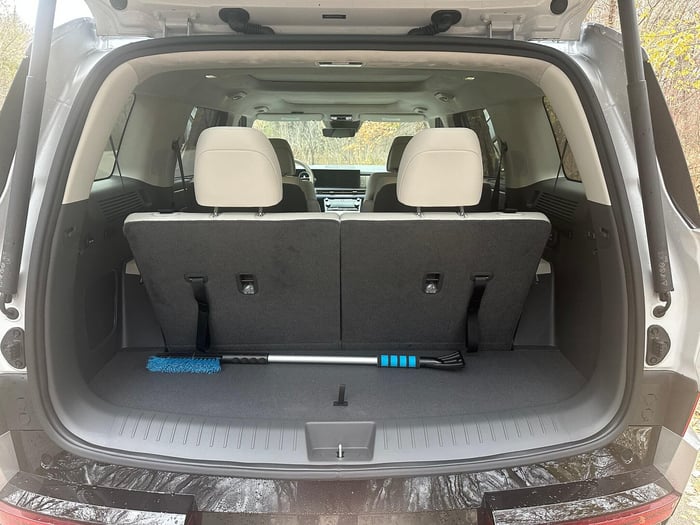
The Hyundai Santa Fe’s Hybrid driveline consists of a 1.6-liter turbocharged four-cylinder engine with an electric motor, a 6-speed automatic transmission and the HTrac all-wheel drive system. Combined, this driveline is rated at 231 horsepower and 271 pound-feet of torque.
This driveline puts down smooth power with no interruption between the ICE and electric motors. It also does a great job cruising down the highway while exhibiting excellent passing maneuvers. In terms of fuel economy, we averaged 32.0 MPG.
Ride quality was solid and effortless on good road conditions. The suspension system tried to smooth out road imperfections the best it can. The larger wheels and narrow profile tires may be to blame, so you can find a happy medium in with other trims. The Santa Fe Hybrid takes corners quite well, without much lean or roll.
The steering system offered a nice turning radius and solid response from the wheel. On-center feel was fine. The brake pedal felt a bit soft on occasion. The response to the wheels was OK with regenerative energy playing no effect on the system. The Hyundai Santa Fe Hybrid offered decent stops in normal and panic situations. 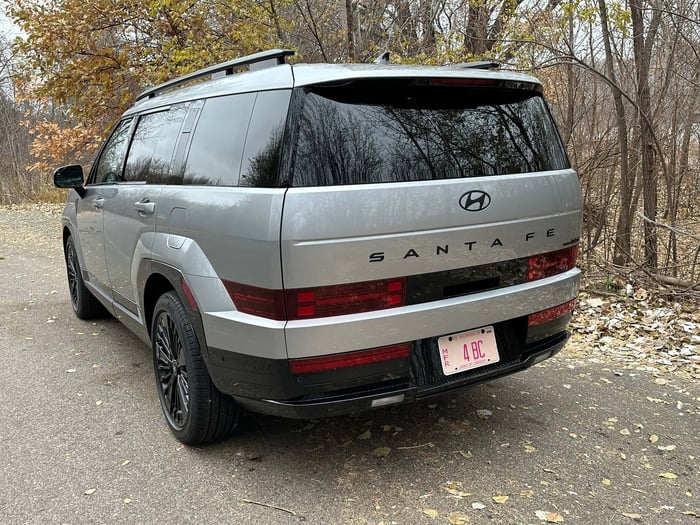
For 2026, you have a choice of four Hyundai Santa Fe Hybrid trim levels. Pricing starts at $36,150. Our Calligraphy Hybrid tester came with a sticker price of $51,985. You also have a choice of five additional trim levels with the regular turbocharged internal combustion engine.
How does the Santa Fe Hybrid stack up with its competitors? It is comparable to the Kia Sorento Hybrid, Toyota Crown Signia and Highlander Hybrid, Mazda CX-70 and CX-90 PHEV, Jeep Grand Cherokee 4xe and Mitsubishi Outlander PHEV.
This is a vehicle full of choices. The most important choice should be whether the 2026 Santa Fe Hybrid is the right SUV for you. You may find that it is indeed something worth putting on your shopping list.