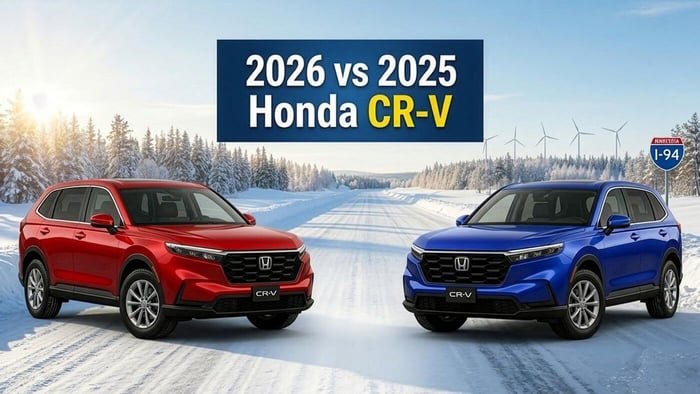

Why Minnesota Drivers Are Split On CR-V Years
You came for a Minnesota buyer’s guide to winter-ready value—so picture your 6 a.m. commute on I-94 (Interstate 94), salt flying, potholes lurking. Do you stretch for a 2026 with fresh tech, or grab a discounted 2025 and pocket a few thousand? In our winters, tiny specs loom large: AWD (all-wheel drive) logic in Snow mode (adjusts throttle and traction), a heated steering wheel, and 18-inch wheels that take affordable, grippy winter tires.
Now layer in timing and availability you actually feel on I-35W (Interstate 35W) or US-61 (U.S. Highway 61): a 2025 you can drive home today versus a 2026 with a waitlist. Month-end incentives often sweeten outgoing-year deals, while the newer badge can slow depreciation (value drop) in year one. Your budget, your driveway, your route. That’s why smart buyers are split.
So what actually changed from 2025 to 2026 that matters here? We’ll cut past hype and map specs to Minnesota realities: snow traction, cabin weekends to Brainerd and the North Shore, and tight ramps in Minneapolis and St. Paul. Next up, the year-over-year updates you’ll feel on cold pavement.
Table of Contents
- Why Minnesota Drivers Are Split On CR-V Years
- What Changed From 2025 To 2026—And What Didn’t
- Minnesota’s Price–Tech–Winter Tradeoff, In Real Life
- Why Generic Comparison Lists Fail Up Here
- Minnesota CR-V Comparison: 2026 Vs 2025, What Actually Matters
- Tech And Safety That Work In Minnesota Winter
- Which CR-V Year Fits Your Minnesota Life?
- Decide Your Minnesota CR-V In Five Steps
- Minnesota Total Cost: What You’ll Actually Spend After MSRP
- Test-Drive Routes That Reveal The Real Winter Fit
- Hybrid Vs Gas CR-V in Minnesota: Real Winter Answers
- Why Minnesota CR-V Shoppers Trust Carsoup To Decide Faster
- Next Steps: Lock In Your Minnesota-Ready CR-V
- Not Sold On An SUV? Smart Cross-Shop Picks
- Verification, Sources, And Winter Disclaimers
- FAQs
What Changed From 2025 To 2026—And What Didn’t
So what are those year-over-year updates you’ll actually feel on cold pavement? The sixth-generation CR-V, launched for 2023, keeps the same core platform and cabin layout; most 2026 chatter is about packaging and small refinements. Before paying a premium, verify any 2026 claims—larger display, wireless features, or AWD (all-wheel drive) software tweaks—against Honda press materials and official spec pages. If Honda hasn’t published it, mark it “to be confirmed” and compare a 2025 on the lot with a 2026 allocation.
That matters in Minnesota because tiny tweaks can change daily winter comfort and confidence. Glove-friendly controls, reliable remote start, and a steady Snow mode (a drive setting that softens throttle and optimizes traction) beat badge status. Also, confirm EPA (Environmental Protection Agency) ratings and any advanced driver-assistance systems (ADAS) notes for 2026. Then match it to reality: tire sizes you can easily find as winters, dealer build mix, and lead times when a storm is on the radar.
Tech & UX: Verify display sizes, wireless phone features, charging pads; usable with gloves.
AWD & Traction: Confirm 2026 calibration updates; assess packed-snow and slush behavior.
Trims & Wheels: Note 2026 wheel changes; impact on winter tire sizes and sidewalls.
Safety & ADAS: Ensure Honda Sensing parity; confirm any sensor/software refinements.
Efficiency: Verify EPA ratings by year/drivetrain; note winter MPG drop expectations.
Here’s how this hits home: frigid starts demand quick heat, a defrost pattern, and a heated wheel you can count on. Remote start behavior varies by trim and settings; test it. Watch wheel size for affordable winter tires and softer sidewalls. And plan for salt: underbody protection, rubber floor liners, and a wash membership keep a CR-V looking new longer.
Minnesota’s Price–Tech–Winter Tradeoff, In Real Life
Discounts on 2025 are staring you down, while 2026 MSRP (sticker price) sits firm. At 7 a.m. in Eagan, you’re juggling daycare drop-off, frost-covered windows, and black ice at the light. On the U of M campus, tight ramps and packed snow test traction and cameras. Planning a Friday run to Duluth? Crosswinds, lane-keep nudges, and heated seats matter more than a newer badge. The tension is real: save today or buy potential refinements you might barely notice.
You also feel timing pressure. A 2025 on the ground could be in your driveway this week; a 2026 might mean a wait, fewer color choices, or a trim you don’t love. Depreciation favors the newer year on paper, but Minnesota winters reward substance: Snow mode you trust, a heated wheel that warms fast, and 18-inch tires you can source quickly. Tech fear of missing out (FOMO) is real, yet the safest buy is the one ready before winter hits.
St. Paul parents, two kids in hockey, are eyeing a 2025 EX-L with a meaningful discount. It has the heated seats they need and wheels perfect for a winter tire set. But the 2026 tempts them with standard wireless phone integration and whispers about refined AWD tuning. They’re weighing cash for skates and gas against maybe-better tech and traction. And the first snowfall? It’s showing up on their weather app.
Hidden math adds up fast. An aftermarket wireless charger and mount can be hundreds over a few years. A proper winter tire and wheel package often lands in four-figure territory, plus seasonal swap fees. Resale perceptions matter in Minnesota, too: a newer model year may list stronger, but documented winter care and a second wheel-tire set can narrow that gap.
Why Generic Comparison Lists Fail Up Here
Hybrid batteries dislike cold; chemistry slows, so the engine runs more to heat the cabin and keep the pack within its happy range. Expect less electric assist and slower warmup on subzero mornings. Slush coats radar and cameras, triggering warnings and disabling assists until you wipe them. Now, the driveway moment: leaving a plowed apron onto packed snow. AWD (all-wheel drive) programming and Snow mode can change throttle feel and torque delivery, which you notice in the first ten feet.
Generic lists also ignore tires and temps. All-season rubber hardens in single digits, stretching braking distances even with perfect ABS (anti-lock braking system) and ESC (electronic stability control). Headlights ice over, washer fluid gels if it’s not winter-rated, and lane lines vanish under snow—so lane-keeping nudges get jumpy. Remote start helps, but idling forever wastes fuel; pre-set cabin schedules and seat heat do more with less. These nuances matter more than a tiny horsepower change.
Road salt impact: Discuss underbody protection, coatings, and convenient winter wash access.
Plow ridges & ruts: Consider clearance, approach angles, and traction management nuance.
Cabin gear: Plan space for hockey bags, skis; leverage split-fold rear seats.
Cold ergonomics: Prioritize heated seats/wheel, glove-friendly controls, and predictable remote start.
Minnesota CR-V Comparison: 2026 Vs 2025, What Actually Matters
Cold ergonomics matter, so we turned specs into Minnesota outcomes. Read across: 2026 vs 2025 details, winter impact, and our buyer takeaway. Verify each spec with Honda and MPG (miles per gallon) with the EPA, because trims and ratings vary. If a 2026 item is preliminary, mark it to be confirmed. Next, we’ll zoom into tech and safety on icy roads.
Attribute | 2026 Honda CR-V | 2025 Honda CR-V | Minnesota impact | Buyer takeaway |
Powertrain options | Confirm 1.5L turbo gas and two‑motor hybrid availability by trim. | Same engines and trims; verify outputs and tow ratings by trim. | Cold starts, torque delivery on packed snow, cabin heat-up speed. | Hybrid favors city and stop‑and‑go; gas may suit towing. |
AWD system and tuning | AWD (all‑wheel drive) with Intelligent Control; check any 2026 calibration notes. | Established AWD behavior; confirm Snow mode availability by trim. | Plow berm launches, angled driveways, and icy intersections test traction. | If your driveway is steep or unplowed, prioritize AWD performance. |
Infotainment and displays | Verify standard screen sizes, driver display, and physical controls. | Base vs mid‑trim screen differences; physical volume and tuning knobs. | Glove usability and less eyes‑off‑road time on slick commutes. | Pick the interface you can operate by feel in gloves. |
Connectivity and charging | Confirm wireless CarPlay/Android Auto and heated‑friendly wireless charging pad. | Note which trims offer wireless vs wired and pad availability. | Cable‑free helps with bulky coats and frozen cords in deep cold. | Pay for convenience you’ll use daily, especially pre‑dawn starts. |
Safety and ADAS (advanced driver‑assistance systems) | Honda Sensing suite; confirm any camera, radar, or software refinements. | Honda Sensing standard; verify features by trim unchanged. | Slush blocks sensors; lane lines vanish, so lane‑keeping may disengage. | Confidence boost, not autopilot; test assists on I‑94 and I‑494. |
Wheels and tires | Confirm wheel sizes/designs; note 18 vs 19 availability by trim. | Similar sizes; verify exact fitments and recommended winter sizes. | Taller sidewalls improve ride and winter tire selection, especially on ruts. | Consider a smaller‑diameter winter wheel‑tire set for grip and comfort. |
Cargo and practicality | Confirm cargo volume, flat load floor, and split‑fold flexibility. | Same measurements expected; verify rear seat slide and recline. | Hockey bags, skis, strollers, and Costco runs fit with seats folded. | Assume practicality parity; focus on heated features and outlets. |
Efficiency (EPA) | Insert verified EPA (Environmental Protection Agency) ratings by drivetrain when published. | Use official EPA ratings for gas vs hybrid; confirm AWD impact. | Expect 10–25% winter MPG (miles per gallon) drop; remote start adds. | Budget fuel accordingly; hybrids still shine most in city driving. |
Tech And Safety That Work In Minnesota Winter
You’re right to worry—slush can blind sensors and drop MPG (miles per gallon). So let’s turn tech into fewer distractions. Bigger screens and digital clusters (the gauge display) mean quicker glances with gloves on. Wireless charging and wireless CarPlay/Android Auto cut cord hassles in bulky coats. Honda Sensing ADAS (advanced driver-assistance systems) may pause when lane lines vanish; expect beeps and gray icons. A wipe of the radar grille and windshield camera area restores function fast.
Now, traction tech. Snow mode (softens throttle and adjusts traction control) helps smooth pull‑aways on polished ice; use it whenever temps dip and roads glaze. Keep winter‑rated washer fluid, and clear the rearview camera before backing. Test ABS/ESC (anti‑lock brakes/electronic stability control) in an empty, legal lot to feel limits. If your CR‑V lacks a camera washer or wiper de‑icer, carry a microfiber and de-icer spray. Maintenance win: clean sensors weekly and inspect tire pressures every 10–15°F swing.
Bigger central display: Faster glances with gloves on during dark, bumpy commutes.
Wireless everything: Less cable fumbling with thick gloves and kids in back seats.
AWD logic: Smoother pull-away on polished ice if tuning improved.
Driver display: Clearer lane guidance when lines fade under snow and slush.
Prefer hybrid efficiency over SUV ride height for city errands? Consider the 2026 Honda Civic Hybrid Hatchback as a smart, low-slung winter option with great MPG and easy parking.
Which CR-V Year Fits Your Minnesota Life?
If that Civic Hybrid idea had you nodding, great—but you might still want a CR-V. Use these scenario picks as guidance; we recommend testing both years back‑to‑back on your winter route.
Twin Cities commuter: If 2026 adds wireless and smoother assists, pay the premium; otherwise, a 2025 EX/EX-L with Honda Sensing and 18-inch wheels works.
Suburban family (Maple Grove/Eagan): Pick heated seats, LATCH (Lower Anchors and Tethers for Children), and 18-inch wheels; 2025 savings fund a winter wheel‑tire set.
North Shore & cabin trips: Favor the year/trim with all‑wheel drive, ground clearance, and roof rails; 18-inch wheels ease winter tire choices for traction.
Budget-first buyer: Strong 2025 discounts usually win; some shoppers should consider the Used Honda Civic Hatchback 2024 for lower payments and easy winter tires.
Decide Your Minnesota CR-V In Five Steps
If you're leaning budget-first after those scenarios, we built this framework to rank safety, winter capability, tech convenience, then budget—so you pick the year that fits your life, not the hype. Quick and clear.
Step 1: Define routes:
Daily miles; I‑94 (Interstate 94) wind, Lowry Hill Tunnel, neighborhood hills; note steep driveways and plow berms.
Step 2: Rank winter must-haves:
AWD (all‑wheel drive) behavior, heated seats/wheel, wiper de‑icer, remote start; choose items you’ll use five days a week.
Step 3: Tech priorities:
Screen size, wireless Apple CarPlay/Android Auto, dependable wireless charging; must work with gloves and minimize eyes‑off‑road time.
Step 4: Test two trims:
Back‑to‑back drives, same tires, same route, same day; note cabin warm‑up and Snow mode (gentler throttle for traction).
Step 5: Total cost view:
Add winter tires, insurance, Minnesota registration tax, maintenance, wash plan, and resale; choose the lower five‑year number.
Minnesota Total Cost: What You’ll Actually Spend After MSRP
Step 5’s total cost view starts here: Minnesota winters change fuel use, tire plans, maintenance cadence, and resale. We’ll price it out, then take you on MSP test routes.
Winter tires & wheels: Budget $900–$1,600 for 18-inch sets; 19s cost more and ride harsher. Swaps run $100–$160 per year.
Fuel & hybrid savings: Expect 10–25% winter miles‑per‑gallon drop; garage helps. Hybrids save most in city, less on subzero highways.
Insurance & safety tech: Some carriers discount ADAS (driver assists); a windshield with camera/radar can require $250–$600 calibration after replacement.
Corrosion control: Unlimited winter washes run $20–$40/month; underbody spray or coatings $200–$600. Delays rust and preserves brake and fuel lines.
Resale in MN: All-wheel drive (AWD), heated seats/wheel, and infotainment list stronger locally; winter care records and a second wheel set help.
If you’re ultra‑frugal, benchmark total ownership against a proven hybrid like the 2013 Used Toyota Prius Hatchback; it’s not an SUV, but it shows how low fuel and maintenance can go.
Test-Drive Routes That Reveal The Real Winter Fit
You priced the Minnesota costs; now feel the difference. These Twin Cities routes reveal traction, wind noise, visibility, and tech usability so you can compare years on the same day, same tires, same weather.
I-94/I-694 loop: Hold 60–70 miles per hour, feel lane-keeping and adaptive cruise control (ACC) in crosswinds, judge wind noise through the Lowry Hill Tunnel.
Hennepin–Lyndale corridor: Stop‑and‑go downtown, feel hybrid regen (regenerative braking), watch camera alerts in slush, and test brake modulation at low speeds.
Hwy 61 to White Bear Lake: Mix highway speeds, feel rut tracking, evaluate plow berm launches, and check passing response on two‑lane stretches.
Suburban cul-de-sacs (Eagan/Maple Grove): Tight turns, parking ramps, hill starts on packed snow, and practice visibility with kids and gear loading.
Shopping beyond Minnesota? Our nationwide listings let you browse options anywhere—for example, see SUV cars for sale in Ashburn, VA, to compare trims and prices outside the Twin Cities, then come back to local dealers with clearer targets.
Hybrid Vs Gas CR-V in Minnesota: Real Winter Answers
After those test routes—and even if you browsed nationwide—the last call is powertrain: hybrid or gas. Hybrids still need engine heat, so in subzero mornings, the engine runs more, and cabin warm-up can lag. Use remote start in 10–15 minute bursts; seat and wheel heaters do heavy lifting. Regenerative braking (energy recapture when you lift) can feel grabby on slick surfaces; Snow mode (gentler throttle and traction) softens it. Whatever you choose, winter tires beat specs, and a garage shortens warm-up and protects batteries.
Gas trims warm faster on bitter mornings; great for kid drop-offs. Hybrids shine in stop-and-go once warm, but expect 10–25% winter MPG (miles per gallon) drop. If you street-park, consider a block heater (dealer accessory) and a smart charger for the 12‑volt battery. Keep tires at door‑jamb specs; pressure falls 1 psi per 10°F. Prefer 18‑inch wheels for broader winter tire choices and a softer ride.
Mostly urban, <20-mile trips: Hybrid shines despite winter MPG drop; preheat briefly, then let seat heat work.
Long highway commutes: Run the math; gas may pay back faster at MN fuel prices.
Towing/gear-heavy weekends: Favor gas or confirm hybrid ratings; torque helps, but always verify limits.
If you decide smaller is smarter, browse Hatchback cars for sale in Ashburn, VA, for efficient, easy-parking options to benchmark costs.
Why Minnesota CR-V Shoppers Trust Carsoup To Decide Faster
Whether you stick with a CR‑V or just peeked at nationwide hatchback listings, you shouldn’t have to piece this together alone. We’re Minnesota‑first—built around local dealers, winter roads, and the way you drive. Our listings span over a million new and used vehicles, and Soupy AI (artificial intelligence) turns trim jargon into plain English. You can track values, set price alerts, and check recall status in one place. The payoff: clear, Minnesota‑specific picks for snow, salt, and school‑drop‑off realities.
Need a faster path to yes? Save three CR‑V candidates, set price‑drop alerts in under five minutes, and we’ll surface out‑the‑door estimates, financing options, and nearby test‑drive slots. Our Minnesota filters spotlight 18‑inch wheel trims for easier winter tires and call out heated seats/wheel, remote start behavior, and Snow mode notes. Example: we’ll flag the 2025 EX‑L vs 2026 Sport‑L tradeoff—heated wheel availability and $900–$1,600 winter tire costs—so you see the real gap before you drive.
We’re Minnesota‑first, but our reach is national—browse examples like cars for sale in Ashburn, VA, or brand-specific Honda for sale in Ashburn, VA, to gauge pricing elsewhere while using this guide for Minnesota decisions.
Next Steps: Lock In Your Minnesota-Ready CR-V
Those national price checks give you context—now let’s make a Minnesota move. Compare 2026 vs 2025 in our table, shortlist two trims, then book back-to-back test drives on winter roads. Same day. Same route. You’ll feel the winner fast.
Compare side by side: Use the Minnesota table above, then shortlist two trims and save them.
Book back-to-back drives: Same day, same route in MSP; aim for snow or slush to compare traction and warm-up.
Get guided help: Ask Soupy AI to refine trims, options, out-the-door budget, and trade-in; set price-drop alerts and finance pre-approval.
Not Sold On An SUV? Smart Cross-Shop Picks
Comparing CR‑V deals near you is smart, but you might realize an SUV isn’t the perfect fit. If you want high MPG (miles per gallon) and easy parking, try compact hybrids and hatchbacks like Civic Hybrid or Prius. They sip fuel in winter traffic, take affordable 17–18 inch winters, and fit tight ramps. Tell us your commute; we’ll shortlist three within budget.
Verification, Sources, And Winter Disclaimers
Before we shortlist anything for you, we verify the details against Honda press materials, owner’s manuals, and official EPA (Environmental Protection Agency) ratings for 2025 and 2026. Photos are illustrative only; equipment and colors vary by trim and dealer inventory. Cold weather changes results—subzero starts, remote idling, and winter tires can reduce MPG/range by 10–25% and affect driver-assist performance. So use our numbers as guides, then confirm on your test drive and at delivery.
We keep this guide updated, but always treat 2026 feature notes as “to be confirmed” until you see the window sticker and owner’s manual for your VIN (vehicle identification number). EPA tests are standardized; your mileage will vary based on temperature, speed, payload, and maintenance. Images may show non‑U.S. models or accessories. When in doubt, follow Honda’s manual for ADAS (driver assists) behavior in snow and ice.
FAQs
What are the main differences between the 2025 and 2026 Honda CR-V?
The 2026 model is largely a carryover of the sixth-generation platform. While the core layout remains the same, the 2026 model focuses on packaging updates and small tech refinements, such as potential improvements to wireless features and AWD software calibration.
Is it better to buy a 2025 or wait for a 2026?
It depends on your timeline and budget. A 2025 model is often available for immediate delivery and may come with year-end incentives. A 2026 model may have a waitlist but generally offers slower initial depreciation and the latest (though incremental) tech updates.
How does the CR-V Hybrid perform in extreme cold?
Hybrid batteries can be less efficient in subzero temperatures, meaning the gas engine will run more frequently to provide cabin heat. You should expect a 10–25% drop in MPG during peak winter months.
Does the CR-V have a specific "Snow Mode"?
Yes. Both years feature a Snow mode that softens throttle response and optimizes traction control to help you pull away smoothly on polished ice or packed snow.
Which wheel size is best for Minnesota winters?
The guide recommends 18-inch wheels over 19-inch wheels. 18-inch tires offer a softer ride on winter ruts and provide a wider, more affordable selection of dedicated winter tires.