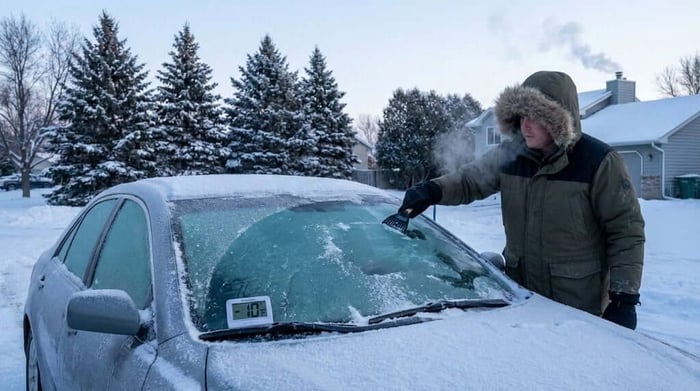

If you live in Minnesota, you know the sound. It’s that sluggish, groaning noise your engine makes when you turn the key on a morning when the air hurts your face. It’s -10°F, the wind chill is pushing -30°F, and your car is protesting just as much as you are. We call it "The Deep Freeze." It’s that special time of year when Minnesotans stop talking about "how much snow we got" and start trading war stories about block heaters and frozen door locks. But here at CarSoup, we know that getting your car to start—and keeping it running—in these temps isn't just about luck. It’s about preparation and knowing exactly how your vehicle reacts to extreme cold. Extreme cold car care is a specific beast. It’s different from standard winter maintenance.
When the mercury drops this low, oil turns to molasses, batteries lose half their power, and rubber tires become as hard as hockey pucks. If you’ve ever sat in your driveway in Savage or St. Cloud praying for the engine to catch, this guide is for you. Here is everything you need to know to keep moving when Minnesota freezes over.
Table of Contents
The Heart of the Matter: Cold Battery Tips for Sub-Zero Starts
Your battery is the most vulnerable component of your vehicle during a polar vortex. To put it simply: batteries hate the cold. At 0°F, a standard car battery has lost about 60% of its strength, yet the engine requires nearly twice as much power to turn over. That is a bad math equation for your morning commute.
Know Your Cold Cranking Amps (CCA)
You’ll often hear mechanics talk about "CCA." This stands for Cold Cranking Amps. It is a rating that measures a battery's ability to start an engine in cold temperatures.
The Rule of Thumb: In Minnesota, you generally want a battery with at least 600-700 CCA, though larger trucks and SUVs may need 800+.
The Age Factor: If your battery is more than 3 to 4 years old, it is living on borrowed time. The chemical reaction inside the battery slows down drastically in extreme cold. If it’s old, it simply won’t generate enough electrons to wake up your starter.
To Idle or Not to Idle?
There is a massive debate about how long to warm up a car. In the old days of carburetors, you had to warm the car for 10-15 minutes. With modern fuel-injected cars, that is actually bad advice.
The Sweet Spot: You only need to idle for about 30 to 60 seconds to get the oil circulating.
The Exception: When it is -10°F or worse, give it a little longer—maybe 3 to 5 minutes. You aren't doing it for the engine’s combustion; you are doing it to warm the oil slightly and, more importantly, to ensure your windshield is clear and the cabin is safe for you.
When Starting a Cold Car: Avoid Flooding Your Engine
Have you ever flooded your engine trying to start it in the cold? It happens when you crank the key repeatedly, dumping fuel into the cylinders without a spark, wetting the spark plugs.
If your car is cranking but not starting:
Don't keep cranking. You will kill the battery and overheat the starter.
Try the "Clear Flood" method. Press the gas pedal all the way to the floor and hold it there while you crank the engine for up to 10 seconds.
Why this works: The car’s computer (ECU) recognizes wide-open throttle during cranking as a signal to cut off fuel injectors. This pumps air through the engine, drying out the spark plugs.
Release and Retry. After a few seconds, release the pedal and try to start normally.
Fluids: The Lifeblood of Your Vehicle
When we talk about extreme cold car care, fluids are usually the culprit for major failures.
Engine Oil Viscosity
Oil gets thicker as it gets colder. If you are using 10W-30 oil, it might turn into a gel at -20°F.
Check your owner's manual. Many manufacturers recommend switching to a thinner oil, like 5W-30 or even 0W-20, for winter months. The "W" stands for Winter. The lower the number preceding the "W," the better the oil flows at low temperatures.
The Gas Tank Rule
You have likely heard this from your parents, and they were right: Never let your gas tank drop below half full in the winter.
Condensation: Empty space in your gas tank is filled with air. When the temp fluctuates, moisture in that air condenses into water droplets. Water is heavier than gas, so it sinks to the bottom, enters your fuel lines, and freezes.
The Fix: Keep it half full. If you suspect water in the line (sputtering engine), use a fuel additive like HEET (the red bottle for typical moisture removal) to absorb the water.
Washer Fluid
The Blue Ice Block: Generic "blue" washer fluid often freezes around 32°F or 0°F depending on the mix. In a Minnesota January, that isn't good enough. You need "purple" or "orange" rated de-icer fluid capable of staying liquid at -25°F or -30°F. There is nothing more dangerous than hitting the spray button on I-35W and having a sheet of opaque ice instantly blind you.
Tire Pressure and Traction
The Ideal Gas Law in Action
For every 10-degree drop in temperature, your tires lose about 1 PSI of pressure. If you last filled your tires in October when it was 50°F, and now it is -10°F, your tires could be down 6 PSI or more.
Why it matters: Under-inflated tires have more rolling resistance (wasting gas) and, more importantly, they don't grip the snow as well. They can also fail catastrophically if the sidewall overheats from flexing, though overheating is less of a risk in winter than summer.
The Light: If your TPMS (Tire Pressure Monitoring System) light comes on, don't ignore it. Fill your tires to the manufacturer's recommended level (usually found on the sticker inside the driver's door jamb, not on the tire itself).
What NOT To Do in Extreme Cold
We have covered what to do, but preventing damage is just as important. Here are three things you should strictly avoid:
Don't Use Hot Water on Windshields: It seems like a quick hack to melt ice, but the thermal shock will shatter your glass instantly. Use a proper scraper and the defroster.
Don't Force Frozen Locks: If your key won't turn or the door handle is stuck, don't force it. You will snap the key or the plastic handle. Use a silicone lock de-icer or even hand sanitizer (the alcohol melts ice) on the key blade.
Don't Leave Damp Items in the Car: Wet floor mats or gym clothes create humidity inside the car. That humidity turns into frost on the inside of your windows, which is a nightmare to scrape off.
The Ultimate Minnesota Emergency Kit
If your car dies in extreme cold, the situation becomes life-threatening very quickly. Your cell phone battery will also drain rapidly in the cold. Every Minnesotan needs a "survival bin" in the trunk.
Warmth: A wool blanket, spare winter boots, and a hat/gloves set.
Power: A portable jump starter pack (Lithium-ion packs are great, but keep them fully charged; they also struggle in extreme cold, so bring it inside at night if possible).
Visibility: A flashlight and road flares.
Traction: A small bag of kitty litter or sand.
Summary: Stay Warm, Stay Safe
Extreme cold car care is about anticipating the freeze. It’s about getting the right vehicle for winter driving. It's about checking your battery in November, not January. It’s keeping that gas tank full and respecting the weather. Minnesota winters are beautiful, but they demand respect. By following these winter car tips, you ensure that your vehicle is as tough as the person driving it.
Stay warm out there, Minnesota!
FAQs
How cold is too cold to start a car?
While modern cars are tested to -40°F, most vehicles begin to struggle significantly around -15°F to -20°F. If your battery is old or your oil is thick, starting may be difficult at 0°F. Using a block heater at temps below 0°F is highly recommended in Minnesota.
Does putting a blanket over the engine help?
Placing a blanket over the engine while it is parked in a garage can retain some residual heat for a short time, but it generally isn't effective for overnight outdoor parking. A better investment is a block heater or a battery blanket warmer that plugs into an outlet.
Why does my tire pressure light come on when it gets cold?
Cold air compresses. Your tire pressure drops roughly 1 PSI for every 10 degrees Fahrenheit the temperature drops. The light is a warning that your tires are under-inflated, which affects traction and safety.
Should I lift my windshield wipers before a snowstorm?
Yes, lifting wipers prevents the rubber blades from freezing to the windshield glass. If they freeze to the glass and you turn the wiper motor on, you can tear the rubber or burn out the wiper motor.
Is it bad to drive a cold car immediately?
You should not drive immediately if you can’t see out the windows. Mechanically, it is best to idle for 30-60 seconds to circulate oil, then drive gently. Avoid hard acceleration until the temperature gauge begins to move, as the transmission fluid and suspension components are also stiff.
What is the "Clear Flood" mode for starting a car?
It is a feature in most modern fuel-injected cars. If your engine is flooded with gas and won't start, hold the gas pedal all the way to the floor while cranking. This tells the computer to cut off fuel and pump only air, drying out the spark plugs.