Table of Contents
By late 2025, the terminology surrounding "self-driving" cars has become a marketing minefield. If you walk into a showroom today, you might hear about "Autopilot," "Full Self-Driving Capability," "Super Cruise," or "BlueCruise." These names evoke a future where you can nap in the backseat while your car whisks you to work. However, the reality of the technology on our roads remains vastly different from the science fiction dream of the fully autonomous pod.
To understand why your Tesla still needs you to pay attention—and why a car without a steering wheel is still years away—we must look at the "Levels of Driving Automation" defined by the Society of Automotive Engineers (SAE). Specifically, we need to examine the massive technological and legal canyon separating the systems we have today (Level 2) from the ultimate goal (Level 5).
The Current Standard: Level 2 (Partial Automation)
As of 2025, the vast majority of "autonomous" features available to consumers fall squarely into Level 2. This level is defined as Partial Driving Automation.
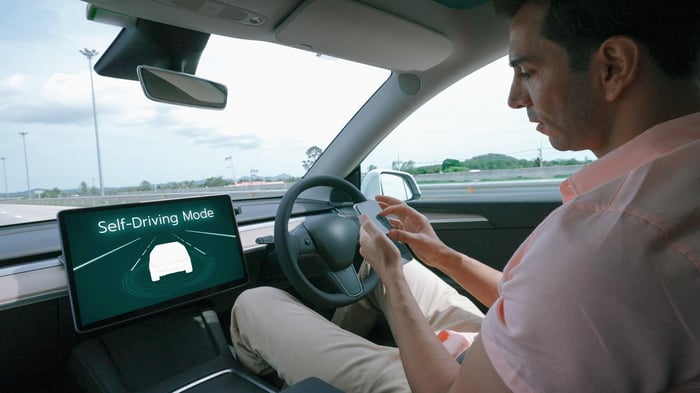
At Level 2, the vehicle can simultaneously handle both steering and acceleration/braking. This allows the car to center itself in a lane and maintain a set distance from the car ahead. However, the defining characteristic of Level 2 is the driver’s liability. The human in the driver's seat is legally responsible for every action the vehicle takes. You are not a passenger; you are a supervisor.
The "Hands-On" vs. "Hands-Free" Confusion
There are two main distinct categories of Level 2 systems, often confusing consumers:
Hands-On Systems (e.g., Tesla Autopilot): These require the driver to keep their hands on the steering wheel to prove they are paying attention. If the torque sensor on the wheel detects no resistance for a set period, the system disengages.
Hands-Free/Eyes-On Systems (e.g., GM Super Cruise, Ford BlueCruise): These systems allow you to physically take your hands off the wheel on pre-mapped highways. However, they use infrared cameras mounted on the steering column to track your eye gaze. If you look down at your phone or close your eyes, the system shouts at you to take control.
In both cases, the "Operational Design Domain" (ODD) is limited. These systems cannot handle every situation. They may struggle with faded lane lines, construction zones, erratic weather, or complex urban intersections. If the system gets confused, it instantly hands control back to you. If you aren't paying attention, a crash is inevitable.
The Ultimate Goal: Level 5 (Full Automation)
Level 5 is the holy grail. It is defined as Full Driving Automation.
A Level 5 vehicle can drive itself everywhere a human driver can—and likely places a human cannot. It can navigate a dirt road in a blizzard, handle a chaotic four-way stop in Mumbai, or merge onto the Autobahn during rush hour. Crucially, a Level 5 vehicle does not need a steering wheel, gas pedal, or brake pedal.
In a Level 5 scenario, every occupant is a passenger. You could tell the car to take your children to school while you stay home, or you could sleep in the back seat during a cross-country road trip. There are no geofences (geographic limitations) and no weather restrictions that wouldn't also stop a human driver.
The Breakdown: Comparing the Levels
To visualize the sheer distance between where we are and where we want to go, it is helpful to look at the breakdown of responsibility and capability.
Feature | Level 2 (Current Tech) | Level 3 (Emerging Tech) | Level 4 (Robotaxi Tech) | Level 5 (Future Tech) |
Primary Driver | Human | System (Conditionally) | System | System |
Monitoring Required? | Yes. You must watch the road constantly. | No. You can look away (e.g., watch a movie) but must take over if alerted. | No. You can sleep. The car handles emergencies. | No. You are purely cargo. |
Steering Wheel? | Required. | Required (for take-over requests). | Optional (but usually present for manual driving zones). | None Required. |
Where it Works (ODD) | Highways & marked roads (Driver supervises). | Specific Highways / Traffic Jams (Traffic Jam Pilot). | Geo-fenced Areas (e.g., Waymo in Phoenix/SF). | Everywhere. |
Liability in Crash | The Human Driver. | The Manufacturer (while system is active). | The Manufacturer/Operator. | The Manufacturer. |
Examples | Tesla Autopilot, GM Super Cruise, Ford BlueCruise. | Mercedes-Benz Drive Pilot (specific states/conditions). | Waymo One (Robotaxis), Cruise. | None currently exist. |
The "March of 9s" Problem
Why haven't we reached Level 5 yet? The answer lies in the "March of 9s."
Level 2 systems are perhaps 95% reliable. They handle the boring, easy miles of highway driving well. To get to Level 5, you don't just need to be 99% reliable; you need to be 99.99999% reliable.
Human drivers are surprisingly good at "edge cases"—rare, unpredictable events. If a Level 2 car sees a person wearing a chicken suit riding a unicycle against traffic, its software might fail because it has never been trained on that data. A human, however, instinctively knows to slow down and move over.
Level 5 requires "General Intelligence"—the ability to understand context and cause-and-effect in a way that current AI, which relies on pattern recognition, struggles to achieve.
Conclusion: Are We There Yet?
As we close out 2025, the gap between Level 2 and Level 5 remains one of the hardest problems in engineering. While companies like Tesla continue to iterate on software that performs impressively in urban environments, they still fundamentally operate as Level 2 systems because they require human supervision.
True Level 5 remains a distant horizon, likely waiting for breakthroughs in sensor fusion, artificial general intelligence, and vehicle-to-infrastructure communication. Until then, keep your eyes on the road—even if your hands are off the wheel.