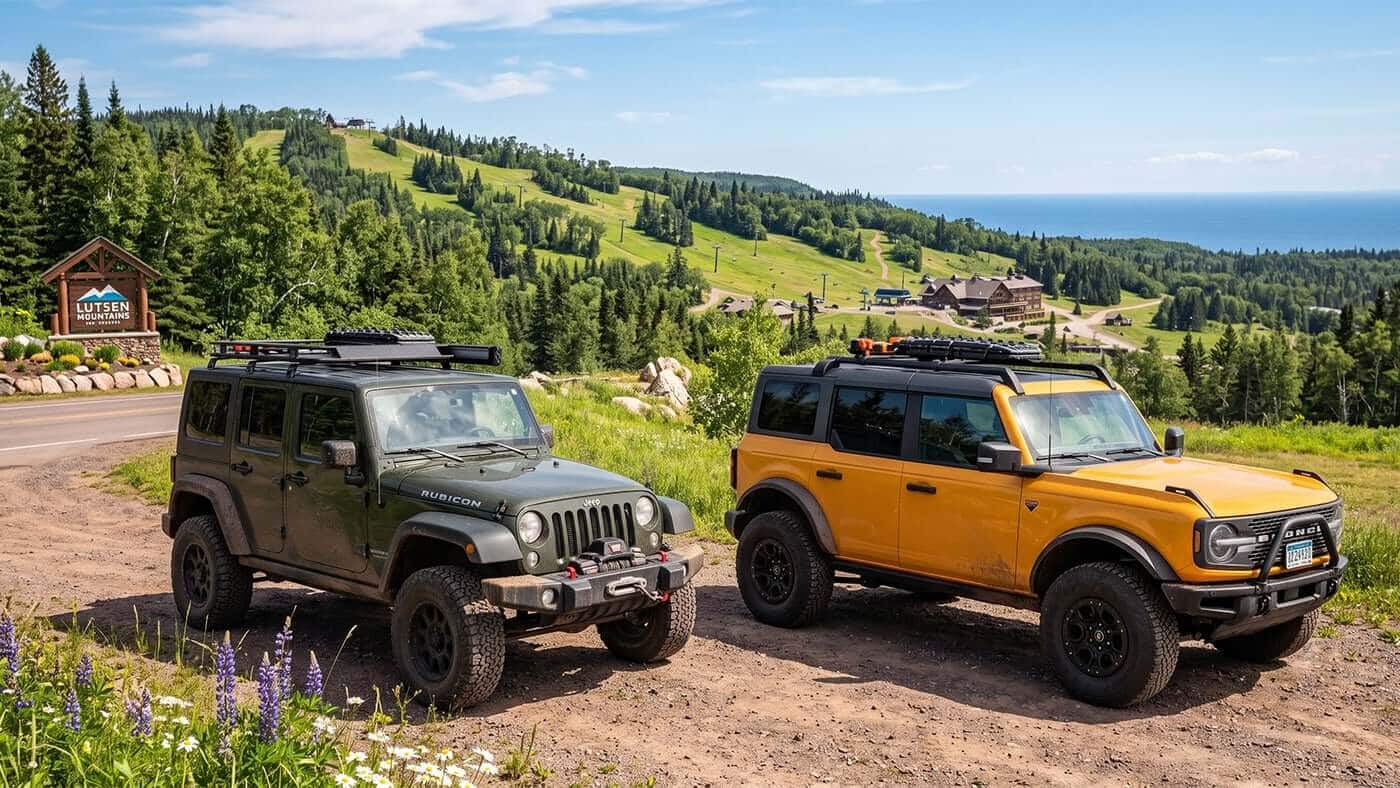

The Jeep Wrangler and Ford Bronco are the two SUVs nearly every trail-minded shopper ends up cross-shopping, and for good reason.
They are not the same truck, though, and the right pick depends entirely on how you'll actually use it. Below, we break down where each one wins, where each one compromises, and how to match a trim to your driving life before you start browsing listings from dealers in your area.
Table of Contents
- Wrangler vs Bronco Specs Comparison Table
- Off-Road Capability: Does the Wrangler or Bronco Perform Better on the Trail?
- Daily Driving and Comfort: Which SUV Is Easier to Live With?
- Wrangler vs Bronco: Which Has the Better Open-Air Experience?
- Wrangler vs Bronco Interior, Technology, and Features
- 2-Door vs 4-Door Models: Which Configuration Makes More Sense?
- Bronco vs Wrangler Price, Ownership Costs, and Value
- Resale Value: Which SUV Holds Its Value Better?
- Who Should Buy a Jeep Wrangler?
- Who Should Buy a Ford Bronco?
- The Bottom Line for Off-Road Shoppers
- FAQs
Wrangler vs Bronco Specs Comparison Table
Specifications | Jeep Wrangler | Ford Bronco |
Starting MSRP | ~$33,000 | ~$39,000 |
Engine options | 2.0L turbo I4, 3.6L V6, 6.4L V8 (392) | 2.3L turbo I4, 2.7L turbo V6 |
Horsepower | 270-470 hp | 300-418 hp (incl. Raptor) |
Torque | 295-470 lb-ft | 325-440 lb-ft |
Transmission | 8-speed auto; 6-speed manual | 10-speed auto; 7-speed manual |
Max ground clearance | up to ~11.6 in (Rubicon) | up to ~11.6 in (Sasquatch) |
Water fording | up to ~30 in | up to ~33.5 in |
Cargo (4-door, behind 1st row) | ~72 cu ft | ~77 cu ft |
Seating | 4 (2-door) / 5 (4-door) | 4 (2-door) / 5 (4-door) |
Max towing | up to 3,500 lb | up to 3,500 lb |
Fuel economy (combined) | ~19-22 mpg (non-V8) | ~18-21 mpg |
Roof / door removal | Doors, hardtop/soft top, fold-down windshield | Doors, hardtop/soft top panels, no fold windshield |
Notable off-road packages | Rubicon, Willys, 392 | Sasquatch, Badlands, Wildtrak, Raptor |
Off-Road Capability: Does the Wrangler or Bronco Perform Better on the Trail?
The Wrangler, especially in Rubicon trim, remains the favorite for rock crawling and technical terrain. Its solid front and rear axles provide exceptional articulation over large obstacles, helping maintain traction on uneven surfaces. Jeep's disconnecting sway bar system further improves capability on challenging trails.
The Bronco takes a different approach with its independent front suspension. This setup delivers a smoother ride on rough roads and performs exceptionally well at higher speeds on desert trails, gravel roads, and mixed terrain. Features such as Trail Turn Assist and the available Sasquatch package make off-roading more approachable for newer drivers.
For extreme rock crawling, the Wrangler still has the advantage. For mixed-terrain adventures and modern trail technology, the Bronco is a strong contender.
Daily Driving and Comfort: Which SUV Is Easier to Live With?
The biggest difference between these SUVs appears when you're driving on pavement.
The Bronco's independent front suspension gives it a smoother, more controlled ride. It generally tracks straighter on highways, absorbs bumps better, and feels more stable during daily commuting.
The Wrangler's solid-axle setup can feel less refined at highway speeds, requiring more steering corrections and transmitting more road imperfections into the cabin. However, many owners view this as part of the Wrangler's rugged personality.
Neither SUV is as quiet or comfortable as a typical crossover, but for most daily drivers, the Bronco provides the better overall driving experience. Buyers who want the rugged look with a calmer everyday ride sometimes land on the Toyota inventory instead, which trades top-removal for proven long-haul comfort.
Wrangler vs Bronco: Which Has the Better Open-Air Experience?
One of the main reasons buyers choose these vehicles is the ability to remove the roof and doors.
The Wrangler remains the leader in pure open-air driving. Its removable doors, multiple roof options, and fold-down windshield create an experience that few vehicles can match.
The Bronco also offers removable doors and roof panels, and its doors can be stored inside the vehicle, a convenience the Wrangler lacks. However, the windshield does not fold down.
Drivers seeking the most authentic open-air experience will likely prefer the Wrangler, while those wanting convenience and flexibility may appreciate the Bronco's design.
Wrangler vs Bronco Interior, Technology, and Features
The Bronco generally feels more modern inside. Its larger available touchscreen, advanced trail technology, multiple terrain modes, and user-friendly interface appeal to buyers who value technology.
The Wrangler's interior has improved significantly over previous generations and includes modern infotainment and available off-road camera systems. While it remains competitive, it feels more traditional compared to the Bronco.
If technology and cabin refinement are priorities, the Bronco has the edge.
2-Door vs 4-Door Models: Which Configuration Makes More Sense?
Choosing between two-door and four-door versions can be just as important as choosing between the Wrangler and Bronco.
Two-door models offer a shorter wheelbase, improved maneuverability, and a classic off-road appearance. They're ideal for enthusiasts who prioritize trail performance and don't regularly carry passengers.
Four-door versions provide more cargo space, easier rear-seat access, greater practicality, and improved highway stability. For most buyers using the vehicle as a daily driver or family SUV, the four-door model is the better choice. You can filter for available short- and long-wheelbase listings when you compare Ford Bronco across local dealers.
Bronco vs Wrangler Price, Ownership Costs, and Value
The Wrangler typically starts at a lower price than the Bronco, making it a more affordable entry point into the removable-top off-road SUV segment.
As trims become more specialized, pricing between the two becomes much closer. High-performance models from either brand can easily exceed $80,000.
Ownership costs are generally similar. Both require larger tires, consume more fuel than typical crossovers, and may have higher maintenance costs than standard SUVs. The Wrangler benefits from a massive aftermarket and parts network, which can make upgrades and repairs easier to source.
Resale Value: Which SUV Holds Its Value Better?
The Wrangler benefits from a long production history and a large service network. Its common issues are well documented, and repairs are familiar to many independent shops.
The Bronco is newer and has experienced some early production issues, but many of those concerns have been addressed in recent model years.
Resale value is one area where the Wrangler continues to stand out. It consistently ranks among the strongest vehicles for value retention, particularly in desirable trims such as the Rubicon. The Bronco also holds value well but does not yet have the same long-term track record.
Who Should Buy a Jeep Wrangler?
Prioritize rock crawling and technical off-roading.
Plan to modify your vehicle extensively.
Want the strongest aftermarket support.
Value long-term resale strength.
Prefer the classic Jeep experience, including the fold-down windshield.
There's a reason it's the default benchmark; you can see how many Wrangler models available span from budget Sport to V8 392.
Who Should Buy a Ford Bronco?
Need a more comfortable daily driver.
Prefer modern technology and trail-assist features.
Spend time on both highways and trails.
Want factory-equipped off-road packages with minimal modifications.
Value a more refined driving experience.
Quick Buying Recommendations
Best for serious off-road enthusiasts: Jeep Wrangler Rubicon (solid axles, articulation, aftermarket depth)
Best for weekend adventurers: Ford Bronco Badlands or Sasquatch (capable, comfortable, easy trail tech)
Best family-friendly option: Bronco 4-door or Wrangler Unlimited (real back seat, more cargo)
Best daily drive: Ford Bronco (smoother highway ride, quieter cabin)
Best for customization: Jeep Wrangler (unmatched parts and accessory ecosystem)
Best value purchase: Used Jeep Wrangler Sport or a lightly used Bronco Big Bend
The Bottom Line for Off-Road Shoppers
There's no universal winner here, only the right match for your driving life.
Both are exceptional, and either will deliver the open-air, go-anywhere experience that pulled you toward this segment in the first place. When you're ready to compare real trims and pricing from dealers near you, browse current Jeep Wrangler and Ford Bronco listings, and if a more truck-like build appeals, the pickup trucks and used Toyota 4Runner are worth a look. For a broader shortlist, our guide to the best off-road SUVs compares the whole field.
FAQs
Is the Bronco bigger than the Wrangler?
They're closely matched. The 4-door Bronco offers slightly more cargo room (about 77 vs 72 cubic feet) and a marginally deeper water fording depth, while exterior footprints are similar within each body style. Both come in 2-door and 4-door configurations that change interior space significantly.
Does the Wrangler hold its value better?
Historically, yes. The Wrangler ranks among the best vehicles for retained value, especially Rubicon trims, thanks to enthusiast demand and a deep aftermarket. The Bronco also holds value well above the segment average, but the Wrangler has the longer, more proven resale track record.
Which SUV is better for daily driving?
For most commuters, the Bronco is easier to live with. Its independent front suspension delivers a smoother, more settled highway ride with less steering correction than the solid-axle Wrangler. If open-air character matters more than commuting polish, the Wrangler still satisfies.
Can the Wrangler or Bronco tow more?
Both SUVs are rated for up to roughly 3,500 pounds when properly equipped, so towing capacity isn't a deciding factor between them. That's enough for a small utility trailer, a couple of snowmobiles, or a light camper, but neither is built for heavy-duty towing the way a full-size truck is. If towing is a priority, look closely at the specific trim and axle ratio, since capacity can vary within each lineup.
Is a manual transmission still available on either SUV?
Yes, both offer a manual option for shoppers who want it. The Wrangler pairs its manual with the 3.6L V6, while the Bronco offers a 7-speed manual on select trims with the 2.3L turbo four-cylinder. Manual availability is limited to certain trim levels on both, so it's worth confirming before you fall in love with a specific configuration.
Which one costs less to fill up and maintain?
Fuel costs run close between the two, with the Wrangler's non-V8 engines edging out the Bronco slightly in combined mpg. Routine maintenance costs are comparable as well, though the Wrangler's decades-long production run means parts are often cheaper and more widely available at independent shops. The Bronco's costs have been trending down as more shops gain experience with the platform, but the Wrangler still has the edge for long-term ownership predictability.